Spectrem’s excellent safety record starts with teamwork.
Flying a large aircraft like the Spectrem DC-3 a mere 100 metres above the ground, or manoeuvring a geophysical survey helicopter at below treetop height, requires extreme focus and precision. The slightest mistake could lead to disaster, so safety is always of paramount importance.
At Spectrem, we are proud of our excellent safety record. Safety is part of our company’s DNA, and it’s a value we instil in every member of the Spectrem family. After all, each successful survey flight depends on not just the aircrew, but the entire support team.
Over the last 25 years, Spectrem aircraft have flown in excess of 1.8 million kilometres of line survey without any incidents. For context, that’s the equivalent of almost three return trips to the moon and back, or 45 flights around the Equator.
In order to adhere to the very highest standards of aviation safety, we continually review and modify our operations. We assess every single flight we undertake – before, during and after – looking for potential weaknesses, refining our approach and seeking improvements as we look to eliminate risk and hazards to the greatest extent possible.
One of the reasons behind our immaculate safety record is the way we think about incidents. We don’t refer to ‘accidents’; instead, we say ‘mishaps’. We don’t believe that incidents are the result of bad luck or that they are unavoidable. Rather, they result from human decisions and actions, and systems.
Every mishap has a cause and effect; understanding these means that we can reduce the risk profile even further. With the benefit of extensive survey flight experience, we have modified the way we plan surveys and our approach to risk assessment, upgraded our risk register and constantly refined the way we manage our Safety, Health and Environment (SHE) reviews.

Recording hazards, reducing risk
At Spectrem, we have always believed that recording a range of flight-related hazards (both on the ground and in the air) gives us the insights we need to foster a holistic culture of safety.
We start by reviewing, on a daily basis, the risks related to the areas where we are based. This includes factors such as traffic between airport and hotel, changes to food and water quality and sanitation. We then look at the airport itself, including any risks associated with infrastructure (such as taxiways and fences), and equipment. Traffic management, the quality of air traffic control and the presence of animals, birds or people around the runway can all make a big difference to the risk profile of any specific operation.
Additional monitoring comes into play once a Spectrem aircraft is airborne. This is when factors such as wind and turbulence become important. By its very nature, geophysical survey flying takes place at very low altitude, which both introduces additional risks (terrain, obstacles) and exacerbates hazards that might not be as consequential at greater heights. Even a bird strike can cause considerable damage to both the aircraft and the equipment it carries.
All these and many other hazards are meticulously recorded by Spectrem’s crews prior to, during and after every flight, and reports are sent back to our head office at Lanseria for monitoring. This information is then used in weekly field safety meetings, and drives future risk assessments.
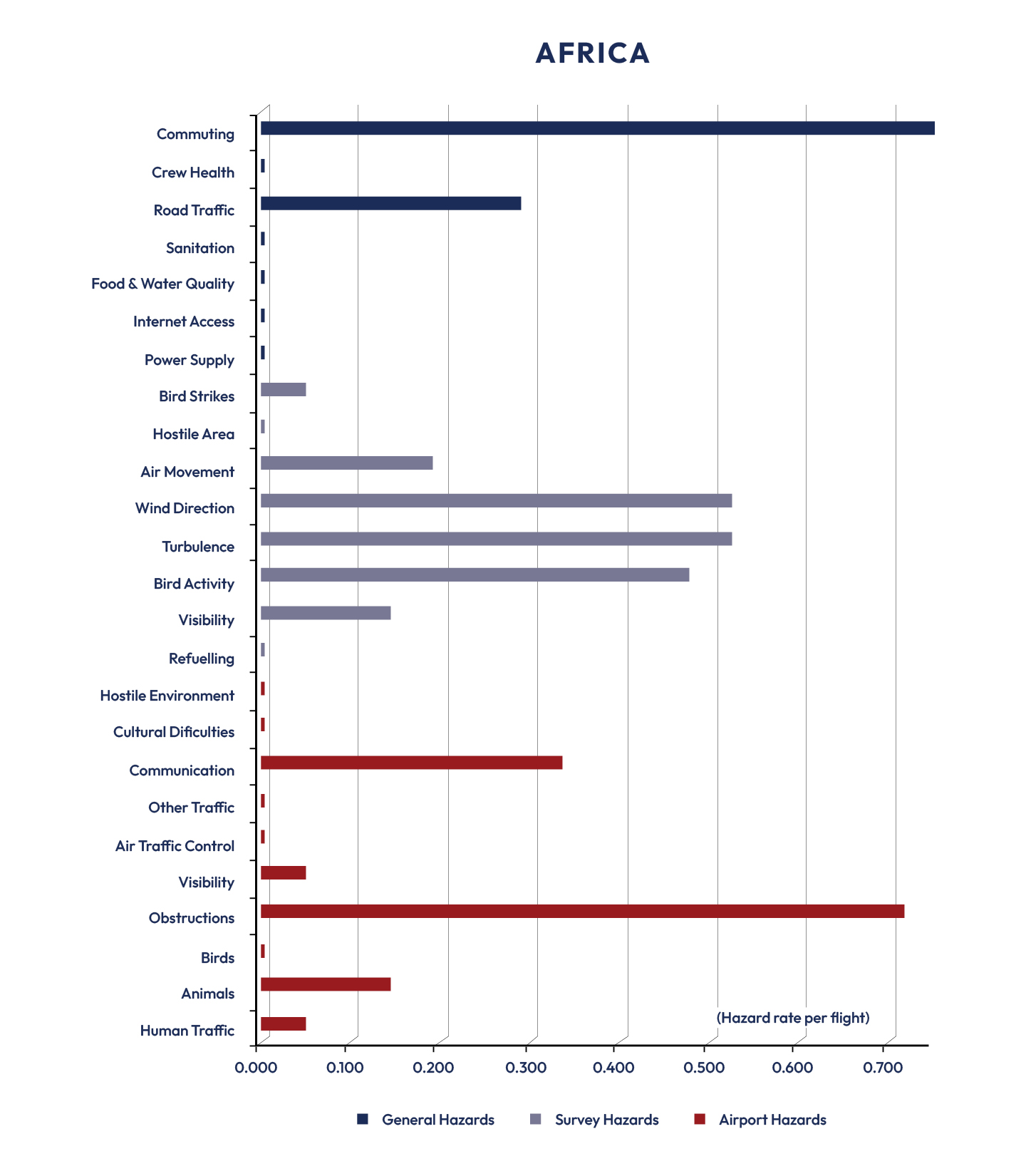
The graph below shows how the assessed relative hazard rate for each aspect of hazard flights in Africa, with the standout risks being road traffic accidents whilst commuting to airports, and obstructions during survey flights. This graph is based on approximately 12 months of survey flying, and it is worth noting that the same graph for a different region of the world, or a different type of aviation operation, could look very different.
Safety starts with us
While regions and risks vary, one thing stays the same: attention to detail and teamwork remain the single most important factors keeping our people and aircraft safe, whether they are in the sky or back on the ground.